A Personal Reflection
These past few days have probably been some of the most “eye opening” days for me personally throughout our entire trip. We’ve been visiting Captain Paul Moulds and the Oasis Youth Support Network – a network of people and services that help the thousands of young people living on Sydney’s streets each night. Unfortunately, homelessness is a real problem in Australia and its cities, as it is in many major cities all over the world. Over 32,000 people under the age of 25 are homeless every night and the numbers are only growing. Luckily, there are wonderful people like Captain Moulds and many others at Oasis who have dedicated their lives to helping these young people, giving them a chance at changing their lives by just being there for them and listening, as my mom elaborated on previously. And while I have certainly been inspired by Paul and his Oasis colleagues, what has impacted me the most has been talking with the kids.
In the past few days, I have gotten to meet several of them and hear their stories – one heartbreaking story after another. Pasts full of abandonment, sexual abuse, drugs, prostitution, sleeping on the streets, being forced to steal food to survive. I watched a young man cry, as he explained how he didn’t have a home because his mom had chosen prostitution over him. I sat and listened to another person describe the numerous ways he has tried to kill himself, without even blinking an eye. One girl showed me her enormous scar running down her back where she had been stabbed while trying to stop a street fight. As horrific as these stories are, what has really affected me is the fact that these people are my peers – many of them are the same age as me. And yet they have already experienced so much pain and neglect, more than I can even imagine. They dream of just having one person they can count on, knowing that there’s someone who cares about them – something I definitely have taken for granted.
This experience has certainly made me reflect on my life and the things that I am very fortunate to have. Two parents who have given me the moon and the stars, and who have supported me in every way. Friends and loved ones who I know I can trust and count on in any situation. A bed to sleep in every night. An education and options for employment. The freedom to choose my own life path. It’s so important to remember that there are many people who don’t have any of these things and don’t believe that they ever will.
I’m happy that say that there is certainly hope for alleviating youth homelessness here in Sydney, thanks to people like Paul who actually do acknowledge and care about the issue. Having that human connection, a person to trust, a person who will listen and be there for you – that certainly is the key, and I’ve seen the results firsthand. I’ve heard many of the kids say that if it weren’t for Paul and the people at Oasis, who listened to their stories and helped them get through each day as they worked through their problems, they would be dead right now. Instead, they’ve started new lives – going to school, getting a job, pursuing a musical career, educating others on the problems of youth homelessness. In fact, we attended an event tonight that was put on by a young guy who went through several Oasis programs, and who recently started his own entertainment business – six months ago he was homeless, with no hopes or dreams in sight. It’s quite amazing to see the power of the human connection and how knowing that someone cares about you can make all the difference in the world.
The Importance of “Family”
We’ve spent the last couple of days with Captain Paul Moulds at Oasis in Sydney, Australia. Oasis is a Salvation Army initiative and a youth support network. They do more than offer “street kids” a meal and a bed to sleep in – they give them a shot at a better future.
Homelessness is a big problem in Sydney, Australia as it is in other civilized, cosmopolitan and economically advantaged cities across the globe. It stands out as a contrast to the wealth and prosperity within the same city confines. And what is most staggering is that the majority of the homeless are young people.
How tragic for youth to start their lives with so many strikes against them. But people like Paul Moulds, his wife Robbin, and countless others are committed to reaching out to these youth to help them find their place in society and hopefully a better future. Paul clearly has a gift with the way he can communicate and “reach” troubled youth. He says it’s his calling and that is evident in just the few hours I’ve spent with him.
Some people would be intimidated or even frightened to venture into the night and talk to the homeless and the “tough” kids that have made a life on the streets, and along with that a life of drugs and violence. Paul may provide a cup of coffee but more importantly, he provides the human connection and the basic human need for communication and belonging.
I spoke with one young man who has been coming to Oasis since he’s been 16 years old. He was thrown out of his house and all he really wants desperately is to be part of a family. His wants are simple – to love and be loved. How very basic and yet so tragic that being part of a family seems so out of reach for so many.
Paul reiterated these same thoughts to me during our interview with him and how important the need for a sense of family is. It’s so easy to forget that coming from a stable family environment and background. But I will never take that for granted again – to know that I have people in my life who care for me and whom I can depend on. People who will be there for me no matter what. And I can’t help but wonder – but for the grace of God – things could have been different for me or for my daughter – merely by chance because of the world we were born into.
After meeting people like Paul Moulds and Ronni Kahn on this great continent and country, I feel so blessed that we had that great fortune and that they agreed to participate in our film. I cannot wait to get this project edited so that I can share with all of you their wonderful words. I truly know now that we were meant to do this film and meet these inspirational people and am convinced that they will be an inspiration for countless others to share their passions and make the world a better place.
Living in the Now
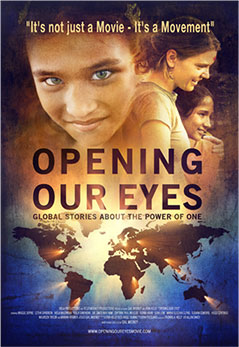
The last couple days have been eye opening as well as reminders as to why I have embarked on this project www.openingoureyes.net. Maybe I needed a reminder at this point in my life that you only go around once and to make the most of it. And after spending a couple days with Ronni Kahn, CEO of Oz Harvest, I got that reminder and it affirmed in my mind why I took a risk, took on a personal project and took off for 3 months on a journey with my daughter around the world.
But Ronni reminded me how important it is that you really only have the “now” in your life because you don’t know what tomorrow may bring. I remember when I first embraced the notion of living in the “now”. I was 19 years old and hitchhiking around the world. I remember a consistent remark from people who stopped to pick me up and bring me a bit further along on my journey. Many of them said, “I wish I had done what you’re doing when I was your age”. I never lost sight of that and have always lived my life with the thought that if I don’t do “it“ now, I may never get the chance again.
No one really knows what tomorrow will bring – that’s the mystery of life. The best-laid plans are never givens and the surprises and unexpected moments are many times the most rewarding.
Tonight, I had a simple yet memorable dinner with my 23-year-old daughter Erin.
As we ate our pizza and had a lovely, inexpensive bottle of wine – we took notice that here we were in Sydney, Australia, overlooking the Sydney Opera House and it all seemed so surreal. But it was real, it a moment in time that we made happen, that we didn’t postpone until the “perfect” time in the future and a time that we will always have and always remember. We were living in the “now” moment.
A Birthday Gift
Today was one of those days that are memorable and just make you feel good to be alive and affirm your life’s convictions. Even though I “worked” today – on my birthday – I realized once again that my “work” has never really felt like work at all, but rather a gift.
Once again, because I am a storyteller and a visual communicator by profession and have the great fortune to have been able to make a living doing so, I had the privilege of spending the afternoon with a remarkable woman. Her name is Ronni Kahn, CEO (Chief Energy Officer as she would say) and founder of Oz Harvest, a food rescue program in Sydney, Australia. What Ronni does is quite simple – yet far reaching. She has set up an organization that picks up food from events, parties, affairs etc. that would have normally been thrown away, and sends it over to various charities that feed the needy.
But one of the many remarkable things that Ronni has done was to use her connections and passion to change the law so that people and organizations who were willing to give away their perishable and left over food, could do so without fear of being sued or liable in the process of doing a good deed. Ronni made it happen because she saw the big picture and overcame the obstacles in the way.
We spent the afternoon with Ronni, first touring around the lovely coastal areas of Sydney, then filming her inspirational interview and ended the afternoon at the beach. One thing stuck with me that Ronni said during the interview. She told me that many people tell her that they would love to get involved and do something along the lines that she has done but that it just wasn’t the right time in their lives and then proceed to give her a variety of reasons of why they can’t. And then she said “if you want to do something – you just need to do it”. You need to stop making excuses and live in the “now”.
As I write this blog entry, her words are kicking around in my head and I realize how grateful I am that I am living in the “now” and doing what I feel I need to do. And that is the best birthday gift of all – nothing can ever top that.
Feels Like Home To Me
This past Saturday morning, we were exploring the Royal Palace and the infamous Temple of the Emerald Buddha in Bangkok, Thailand. The sweat was pouring down our backs and literally dripping off our faces, even when we were just sitting in the shade. We were constantly scratching, our whole bodies covered in mosquito bites. And we were very tired.
By Sunday morning, we found ourselves strolling through the breezy city of Melbourne, Australia. The air was cold and crisp, the wind blowing in our faces felt glorious, we actually wanted to be in the sun, and we felt completely refreshed. We were re-energized, and we’ve been walking all over the city ever since. It is the height of winter here, but to me, it feels like a beautiful fall day in Chicago – perhaps mid to late October.
The city itself reminds me of Chicago, as well. It’s on a big body of water and it has a river running through it. The air is crisp and the wind is always blowing. There are lots of public transportation options. There’s an observation deck in the highest building, like the Sears Tower (although the Eureka Skydeck here is actually the highest viewing deck in the Southern Hemisphere!). And that’s probably where the similarities stop – I know I’m exaggerating the comparison, but I guess that happens when you’re homesick. Oh, if only Chicago winters could be like this!
But in many ways, I do feel like Melbourne could be another U.S. city, with a few positive exceptions. Here are just a few observations I’ve made on things I’ve seen here that I think are pretty awesome and that I would like to see in more U.S. cities (note: I can’t speak for all U.S. cities, as I haven’t been to all of them; I’m just speaking from personal experience):
1. Trams: Melbourne has an extensive city tram network. I know that many U.S. cities used to have trams, but took them down in 50’s and 60’s – something about the wires looking ugly. Listen – trams are cleaner, more environmentally friendly than buses, and they’re fun to hop on and off. Let’s bring back the trams, people!
2. Bike share: Melbourne has a great bike share system and it’s all electronic. There are stations all over the city, and after becoming a member online, you can walk up to any bike and borrow it. The first 30 minutes are free, and if you’re done and you get to a station that’s already full, just press a button on the bike and you get fifteen extra minutes to ride to the nearest station for free. Plus, they’re pretty cool bikes.
3. Self-cleaning public toilets: We came across an interesting site by the river. There was a little building that housed a free public toilet. It cleans itself when it’s not occupied, and it even has a “no loitering” policy to keep the sketchy people out – the door will open and an alarm will sound after 10 minutes of someone going inside. I’m not sure about the 10 minutes rule, but I think the self-cleaning thing is pretty neat.
4. Free public transportation options: Melbourne is extremely visitor friendly. In addition to having a fantastic visitor center, there is a free tourist shuttle that runs all around the city everyday. There’s also a free city circle tram that runs around the city center, stopping at all major destinations.
It was certainly a drastic change going from such temperature and cultural extremes, but it was a needed change. Not that Thailand was that bad – I really loved Thailand and I wished we had spent more time there – I will definitely be returning one day. But now I can understand the language (and listen to the best accent ever), I’m eating hamburgers and drinking wine and actual coffee, walking down the street isn’t a chore, and cold weather never felt so good.
We move on to Sydney now, but I certainly won’t forget the wonderful rejuvenation and Chicago flair that I experienced in Melbourne.
Where No Doctors Go
Yesterday, I was sitting on the floor of a bamboo hut
But that’s not really the point of this blog. As nice and convenient as it was to be able to connect with the rest of the world from such a remote location, I almost didn’t want to. I found myself much more content discussing Thai politics with a fascinating doctor over a bowl of rice, watching the sunset behind the lush green hills. This doctor is Dr. David Marnaw – an inspirational, selfless change-maker who truly understands the meaning of life.
Dr. Marnaw travels among the hill-tribe villages of northern Thailand with his mobile clinic, providing free medical treatment for the villagers. These villages are very remote, with almost no access to medical resources – many people had never even seen a doctor before he arrived and most are unable to go to the hospital due to discrimination from the government. Living conditions are also poor, leading to many health problems – no toilets or sanitation systems, and no safe water supply are the two biggest causes of disease.
He first started working with the villages through a local NGO, but he soon realized that no progress was being made. The donations would come, but the conditions would remain the same. Tired of the corruption, he set off to do the work himself. Everyday he travels to a village, sets up a clinic, treats people for free and gives them medication, as well as clothes and toys, that he collects himself. In addition, he fights sanitation problems at the core, building toilets for every family and constructing water supply systems for villages, sometimes laying a pipeline from a water source over 7 kilometers away. The results are overwhelmingly positive – in the beginning, 90% of the problems people had at his clinic were related to poor water supply and lack of sanitation systems; after building a toilet and water supply, he comes across maybe one case.
But what’s truly astounding is the progress that he has made himself as an individual, with no government-backed funding or grants. His support purely comes from donations through volunteers, who often accompany him in visiting the villages, setting up clinics and carrying out community development projects. He now covers 35 different villages himself, and is constantly on the move. And he doesn’t rest a day.
You may wonder why he would choose such a lifestyle when he’s a doctor and could be living a much more comfortable life elsewhere. His answer – we only live once and he chooses to do what gives him peace and happiness. What a novel idea. An inspirational fellow indeed.
Opening Our Eyes – What’s in a Name?
Little did I know when trying to come up with the right name for our documentary, did I stumble upon and recognize the perfect title “Opening Our Eyes”.
I had been listening to a Jackson Browne song, “Alive In The World” and there it was in Browne’s inspirational lyrics:
“To open my eyes and wake up alive in the world
To open my eyes and fully arrive in the world
With it’s beauty and it’s cruelty
With its heartbreak and it’s joy
With it constantly giving birth to life and to forces that destroy
And the infinite power of change
Alive in the world”
And so on day 50 of our 99-day journey around the world, we’ve reached our midway milestone and with that our eyes are wide open. We have been inspired and deflated, energized and depleted, hot and cold, happy and sad, healthy and ill, hungry and satisfied, content to stay and restless to move on. We’ve run the gamut of emotions, climates and cultures. Yet, we carry on and continue because of the people we have met, who are helping others – the heroes and the subjects of our film. These incredibly selfless people are following their passions and helping others to realize their dreams – giving others a chance at life. That in itself has been a powerful thing to witness and one that has changed our lives.
As we move further on to northern Thailand today, to follow a doctor and trek into the villages of the hill tribes, we leave India behind. This has probably been our toughest week so far. India is a land of extremes. Beauty and history lie beneath extreme poverty and oppressive temperatures that give way to the torrents of the Monsoon. And as hard as I try, it’s difficult for me to grasp an understanding of a caste system that to my mind seems hopeless – at least for the people who are born into the bottom – the untouchables. But it does shed light on why so many seek the boundless opportunities that America offers. And so in trying to understand another culture, I end up understanding my homeland better.
When one travels they begin to know for the first time where they come from and who they are. Perspectives are shaped by real experiences, not from the nightly network news or the black and white print of a newspaper, but from one’s own eyes. It brings a deeper understanding and the desire to know more.
Our eyes have been opened and our hope is to open the eyes of others through our journey and our film. And if you’re reading this Jackson – thanks for the inspiration for the title of our film. And thanks to all of you who follow our journey and encourage us with your support and comments – it means the world.
Revisiting “Standing on a 10 Foot Frozen Wave”
It’s been only 5 months since I wrote about standing on top of a 10 foot frozen wave of Lake Superior in the Upper Peninsula of Michigan.
Seems like a lifetime ago. I couldn’t be further from that wave, both literally and figuratively speaking. As I stood on the crest of that frozen wave, in utter silence with no one in sight for miles, I reflected on the human spirit in this remote part of the world. The sun was setting and I was fearful of slipping into a crevice but yet drawn to the glow of the setting sun – feeling hopeful for the future.
We left Jaipur, India yesterday, with the temperatures nearing the 100 mark and the humidity level the same. But it seemed hotter because everything here in India seems intensified on every level. We’ve been on the road for close to 2 months now and have traversed a variety of climates, cultures, joys and heartbreaks. It’s been easy, hard and everything in between.
In creating this documentary “Opening Our Eyes” we have challenged ourselves in every way we know how. Just shooting a documentary with an HDSLR system, on a slim budget and with a two-person crew is a feat in itself. But this documentary is taking us around the world and putting us in touch with the less fortunate of our planet. It’s humbling, heartbreaking, exhausting, yet somehow a boost to my inner spirit – that same spirit I wrote about back in February when isolated and alone on top of that 10 ft. frozen wave.
How I crave those frigid temperatures and the utter silence of tranquility. Space is a luxury in India with billions of people competing for it. Such an intriguing culture but one that is beyond demanding of all that a body and soul has to give. I draw on my inner strength and my people that came before me who taught me well about struggles and endurance as well as compassion for those who are less fortunate.
My eyes have been opened these past two months in so many ways. To experience and see the extremes of the human condition across the globe has broadened my perspective and put things into balance. What seemed so important just a few months ago, seems so trivial today.
And so it goes as we complete this journey in a few months time. Off to another climate and culture with our eyes opening wider as we go along.
A Short Rant from a Weary Traveler
Traveling is hard. People often forget the troubles that come along with being on the road. Of course exploring new places, meeting new people and learning about other cultures are wonderful experiences – experiences everyone should have. But sometimes, traveling can really beat you down.
The hawkers that won’t leave you alone. The language barriers. The scams. The relentless staring. Being ordered around and then being expected to give a tip. The loss of personal space. The lovely combination of traveler’s diarrhea and food poisoning. The different sense of hygiene. The broken camera. Your taxi driver taking you to a destination that was not your choice. The smells. Having a cold in a hot climate. The ridiculous transit visas. The constant negotiation. Dealing with security – over and over again.
You are faced with these things every single day, and after awhile, you grow weary. But you also learn to cope and adapt to the situation. You find inner strength that you never knew you had. And you grow.
I have personally experienced all of the things listed above, and many within the last few days. And I admit, I have grown weary. But then I also look at those around me, and I feel so fortunate that these are the biggest problems I am facing in my life. I do not have to crawl around on the floor of a filthy train station, begging for money to survive. I do not have to walk over piles of sewage everyday to get to school. This is why you travel – to see these things and appreciate what you have. Yes, I am tired. But I’ll get through it and I’ll be that much stronger for it.
The Children of Kopila Valley
Maggie Doyne told us a story about the youngest resident of the Kopila Valley Children’s Home, Bishal
who is a little more than two years old. He had just come to the home after losing his parents and was barely talking being so young. But one day Maggie heard him saying to the other children in Nepali “My mother and father are dead – what’s to become of me?” Another young boy, barely 4 years old comforted Bishal and told him – “It’s ok we’re all like that”.
And so it is with the children at the home Maggie has built. They are caring and compassionate, look after one another and are all pretty much in the same circumstance. Thanks to Maggie, these precious children have gotten their childhood back and with that a lot of love. Check out this quick pod cast

Kopila podcast
This movie requires Adobe Flash for playback.
Erin and I spent a week with Maggie’s kids
and each day I got to see their smiles, hear their laughter, practice their English and just be kids. And it’s that simple, yet so profound – Maggie’s dream of giving the children a childhood. It gave me pause to think how blessed I am and how fortunate we are to grow up in a country like the United States and have the opportunities it offers. But it also made me think of myself in the context of the rest of the world and how unbalanced things are.
Travel puts things into perspective.
I don’t mean a typical jaunt to one of the world capitals but traveling to places that are outside our cultural norm and you don’t need to go far to do that. In fact you don’t even need to leave the country. I urge all of you to consider your place in the world – to count your blessings and think about those less fortunate.
Our main purpose of our film is to “open our eyes” as a collective and hopefully in our own ways, make a difference. I made a small difference the last day we spent with Maggie. A few months back the town government put in an open sewer trough but they ran out of funds and the trough ended at the entrance to Maggie’s home. It had rained hard the night before and everyone’s sewage and garbage ended up dumped at the gate of Maggie’s property – x’rays, plastic, bottles and feces – dumped right in the path of where her children cross everyday to go to school. We all jumped into the car and went down to the town hall and in my “Michael Moore” moment with camera rolling, walked in and voiced a complaint. I even showed the video of the debris to bear witness to the problem. They promised to send someone out that afternoon to clean up the mess and extend the trough.
It wasn’t much on my part, certainly nothing like Maggie has done, but it made me feel good. I’ll leave you with some images of the children at Maggie’s home and school.
You can become a sponsor of one of the Kopila Valley Children’s Home by visiting Blink Now. Please take a look and if it’s in your heart to help, it will be most appreciated. You’ll be making a difference in a child’s life and who knows where that will lead – maybe even President of the United States.